Showing posts with label books. Show all posts

Monday, December 3, 2012

Investigation #3: eReaders & Digital Books


The newest way to read books, eReaders, such as the Kindle and the iPad among others, has been taking the nation by storm.  Nobody thought that the new technology would take off at such a high rate with consumers.  I do not own one myself, but I can definitely see why people own them or want to own them, there are many pros to this new technology, but there are also cons. 

For most the pros are obvious.  The eReaders allow book lovers to have all of their favorite books present digitally in a tablet.  Instead of lugging your books around everywhere, you only need this tablet, which is small and ideal for traveling.  The introduction of this new technology has caused book prices to drop, and as a result people are reading more now than ever, and it’s hard to argue that reading more is anything else other than a good thing.  Also, having books available digitally is good for the environment because we don’t need to cut down as many trees in order to produce books.  For authors this new technology can be a good thing because people can access their work for lower prices and it makes self-publishing easier which allows for them to be more creative with their writings and take more chances.  It is good for smaller independent publishing companies because they can adapt to this new technology much faster than larger publishing companies. 

There are also cons associated with these eReaders as well.  Authors that rely on visuals in their books are at the mercy of the eReaders technological limitations, many eBook readers have complained that he picture on the eReader tablets are not good and can be confusing.  Also publishing companies have hurries up the production process of these eBooks, leading to more proofreading errors. A major question that these eReaders are raising is whether they will do away with printed books for good.  The number of book stores has decreased from 20,000 twenty years ago to 2,000 as of two years ago.  This phenomenon is in part due to large corporations like Barnes & Noble’s putting smaller book stores out of business, but eReaders have also had an effect.  But how will it affect libraries if printed books go out of style and everyone turns to eReaders to read their favorite books?  Publishers have already set limits on the number of digital books that can be loaned by libraries; many of them have set the limit at 26. 

Perhaps the biggest issue I see with this new technology is how it will effect education.  Education, which in the most part is done through reading books, is all about the access to knowledge and is considered a public good, so everyone should have an equal right in accessing books.  The problem is that if eReaders lead to the decline of printed books, then libraries decline and with it the equal right of everyone to accessing books and thus knowledge.  Only the people who can afford eReaders will have access to most of the books being published, and the poor will be stuck to find another access to knowledge, or else another way to access the knowledge will need to be provided to them.         
 

Investigation: eReaders & Digital Books


eBooks are the future and the future is now. “According to The Pew Internet and American Life Project about 20% of all Americans have read a digital book in the past year.” The dilemma between eBooks and books lies in their differences of physical and electronic. Both of these options for reading have their advantages in trying to simplify how an individual reads a book.

Advantages of books include being able to share reading material with individuals as well as not having to worry about charging your eBook device. When you go digital, especially for individuals who have been reading books before eBooks were created lose the sense of smell and the richness and warmth that a book has to offer. This cannot be capture if an individual is reading an eBook.
However, not surprisingly, reading while traveling and being able to get a book quickly are two advantages that eBooks have over regular books. The fact that the growing market for the number of eBook readers has increased is because there are more eBook devise than ever. Pew believes this growth occurred is because of eBook devices given as gifts during the holiday season. These include popular eReaders such as Apple’s iPad, Amazon’s Kindle and Barnes & Noble’s Nook.


Digitization has advanced rapidly which is why I think some individuals are having trouble adapting. This regards mostly individuals aged thirty and above. I do not think there has to be a battle against digitization. For example when we see titles such as "ebooks vs. real books?", an individual should use which ever device (physical or electronic) is better at the time. Digitization should help us simplify tasks and not cause these "battles" between the old and the new.


Sources:


Saturday, December 1, 2012

eReaders, Education, and the Future of Books

     To be honest, I'm at cross when it comes to eReaders. I would think if I wanted to buy something to read digital books on, I would get a tablet. I'm a fan of Apple, and so I'm not opposed to owning an iPad and Apple has their own version of an eReader that's available on just about all of their mobile devices. Now, after some research, I've noticed that some eReaders like the Kindle Fire behave much like other tablets with internet capabilities and such. Falcone (2012) of CNET breaks down the differences between tablets and several eReaders and how each caters to specific needs depending on who's buying. The internet capabilities of some of these eReaders make them more appealing to me, but I would still prefer an iPad. I don't know the statistics on who else thinks like me, but after some pondering, I thought that a good market for purely eReaders would be schools. For instance, Falcone (2012) discusses how Amazon's entry level Kindle is an e-ink reader that has some online functionality (perhaps to download more texts), but no other internet distractions. However, other eReaders with greater internet functionality are finding their ways into schools, which it turns out, can be beneficial as well as harmful.

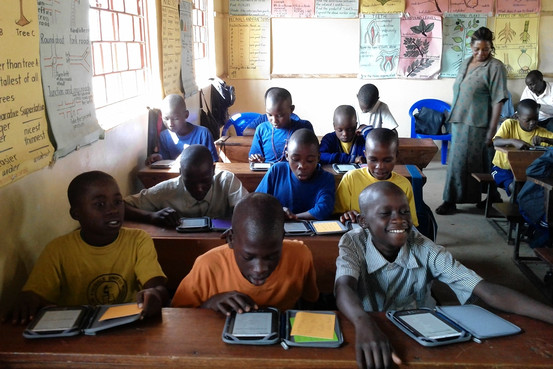
Michael Kozlowski (2012) shows the potential for the educational good that can come from eReaders in the classroom. To be clear, he discusses how globalization has allowed eReaders to be used in classrooms in developing countries, but I don't see why the results wouldn't be the same in America. He notes that literacy rates and standardized test scores have risen since some experimental projects where eReaders have been distributed in Ghana. He also describes how there are expected distractions that come from internet access, but I would argue that this may be more so in such countries because of a lack of exposure to such technology. It seems that kids today are almost born with a smart device in-hand when they exit the womb. While American children are not above getting distracted than any other child, I think that American children are more accustomed to such technology and may not get distracted as easily. But that's just my opinion.
     Of course, there is a flip-side to this benefit: Lorien Crow (2012) discusses how eReaders may actually be harmful to memory functions. She describes how various research shows that when reading printed material on paper, there is more success in knowing the material rather than just remembering the material. She also discusses how the brain has an easier job at making "mental bookmarks" when reading off printed material rather than digital material. What she says it basically comes down to is how the reader is able to process the information. That there are many distractions that come with digital media, but there are benefits as well, it's simply up to the reader to take control over what they are reading.

Another issue that I came across when doing my research is what will happen to the relationship between children and books? Ingram (2012) shows that books are going anywhere, and that those who use eReaders are likely to purchase more physical books. He argues this because people are reading more because of eReaders. However, McMartin (2012) of Vancouver Sun argues that eReaders are taking away the intimacy of books. That the ease and efficiency that eReaders and tablets offer causes children today to lose those moments in time when they read a book that they simply got lost in. Therefore, with the way education is heading in terms of digital resources, perhaps this generation of children will not be more likely to but books just because they read more. It will be interesting to see how the brain develops to the use of digital print and how publishers will tailor their resources for education as the technology for digital print advances.